Advisors
llms.txt Advisor
A weekly audit of your live llms.txt against the spec, with a compliant file written out for you to publish.
What this is
llms.txt is a plain-text Markdown file a site publishes at the root of its
own domain (/llms.txt) so AI engines have a short, curated map of what
the site is and which pages matter, in the shape the llmstxt.org spec
defines: a title, an optional summary, and sections of links.
llms.txt Advisor fetches
your project's live /llms.txt, checks it against that spec with a fixed,
deterministic rule set, then has a model draft a compliant replacement for
you to publish yourself
(api/services/llms_txt/validate.py#validate_llms_txt,
api/services/llms_txt/service.py#run_llms_txt_audit). It is gated on
your plan; see Pricing.
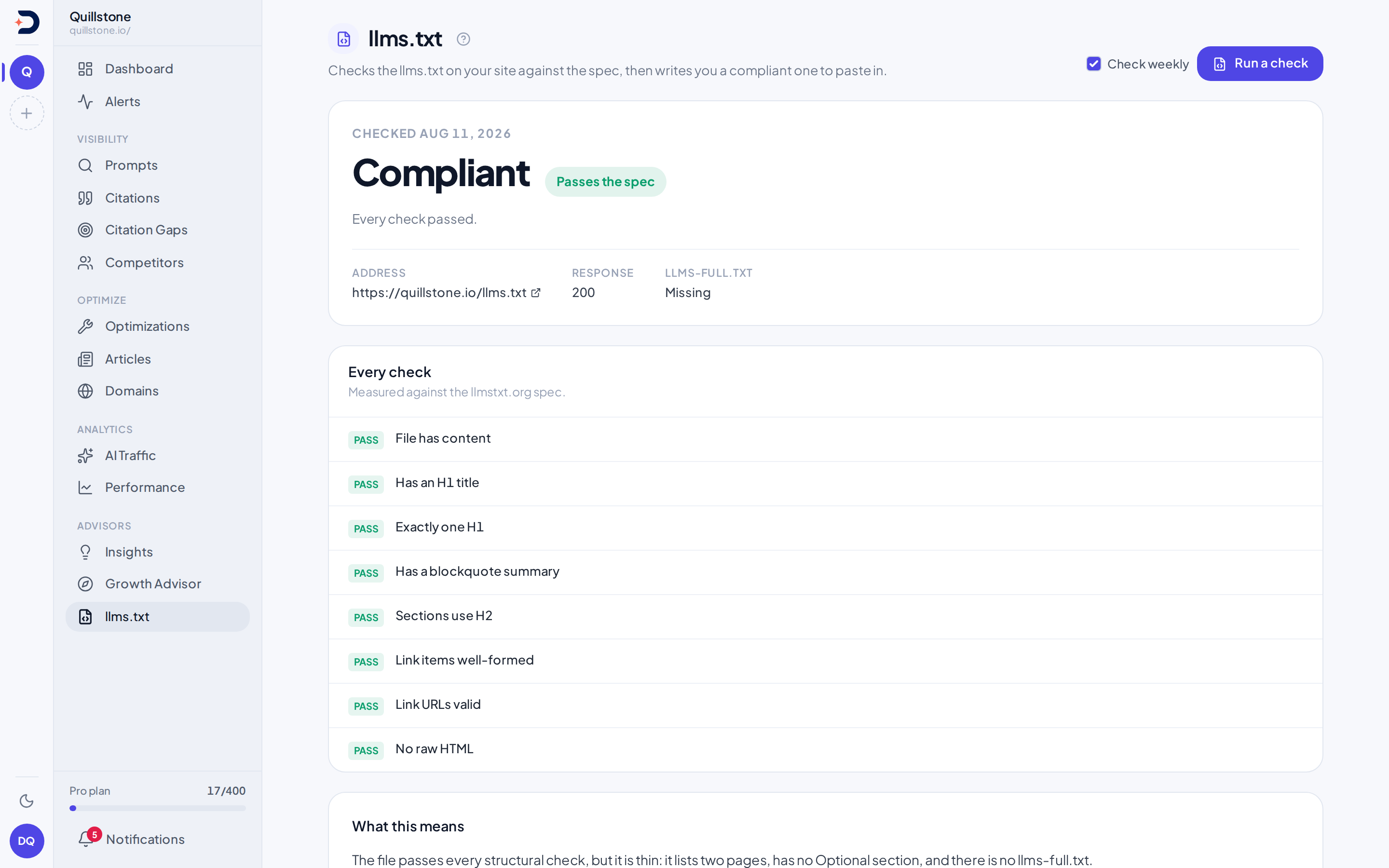
The checklist: eight rules against the spec, and one note
For a file that has content, the checklist runs in the order below. Eight of
the nine entries run every time; the ## Optional note is the exception,
appearing only for a file that has such a section, so a file without one
shows eight. Only the first two can fail; everything else tops out at a
warning
(api/services/llms_txt/validate.py#validate_llms_txt):
- File has content: fails if nothing was fetched or the file is empty.
- Has an H1 title: fails unless the very first line is a single
#heading. - Exactly one H1: warns if more than one H1 heading is present.
- Has a blockquote summary: warns unless one of the five lines right
after the title starts with
>. - Sections use H2: warns if any heading goes deeper than H2.
- Link items well-formed: warns if a bullet under a section is not a
markdown link such as
[label](https://example.com/page). - Link URLs valid: warns if a link's URL is empty or uses an unsafe
scheme such as
javascript:. - Has an Optional section: informational only, and the one entry that is
not always there: it appears only when a heading titled
## Optionalis present, and it is never scored. - No raw HTML: warns if a raw HTML tag appears outside a blockquote line.
A file that is empty or was not found is a special case: only the first two checks run and both fail, rather than the rest being shown as passing something they never had a chance to look at.
What "compliant" means, and what it does not check
Because only "File has content" and "Has an H1 title" can fail, compliant
here means exactly that: the file exists and opens with a # title
line. Every other rule can raise a warning without changing that verdict.
The checklist is a structural check against the spec's shape, not the
whole spec: it does not follow any linked URL to confirm the page still
exists, and it does not judge whether a summary or a link description is
any good. A sibling file some sites publish, llms-full.txt, is checked
only for whether a file is served at that address, shown on screen
alongside the file's response status; that presence check is not part of
the checklist and does not affect whether the file is compliant
(api/services/llms_txt/fetch.py#llms_full_txt_exists).
Running one, on demand or weekly
"Run a check" starts an audit immediately if the project owner's plan
includes the advisor. Editors and owners can start one; a viewer sees the
button disabled, both the one in the page header and the second one this
screen's empty state shows when a project has no audits yet, each with a
role notice above it saying why
(api/routers/llms_txt_advisor.py#trigger_audit, #_trigger_block_reason,
#TRIGGER_COOLDOWN_HOURS,
frontend/src/routes/(app)/llms-txt-advisor/+page.svelte#writable).
Separately, the project's owner can turn on a
weekly automatic check from the same screen; turning it on is gated on the
same plan check as running one on demand
(api/routers/projects.py#update_project). An editor sees that "Check
weekly" checkbox too, rather than it being left off the screen, but it
renders disabled with its own notice that the schedule is owner-only
(frontend/src/routes/(app)/llms-txt-advisor/+page.svelte#owner). Once it is on, a systemd timer
fires every Tuesday at 05:00 UTC and enqueues one audit for every
opted-in project that is itself active, whose owner is active and on a
paid plan, and that has no audit already running or started within the
last 7 days, so running one yourself pushes that project's next automatic
check back rather than doubling up
(discoveredby-cli@enqueue-llms-txt-advisor-refresh.timer,
api/tasks.py#_enqueue_llms_txt_advisor_refresh_for_eligible_projects,
#LLMS_TXT_ADVISOR_REFRESH_INTERVAL_DAYS, #generate_llms_txt_audit_task).
The file it writes, and what you do with it
The one thing this feature does with your site is read from it: fetching
your current /llms.txt is a GET request, nothing more
(api/services/llms_txt/fetch.py#fetch_llms_txt). The compliant file a
model drafts afterward, proposed_llms_txt, is saved to the audit row and
rendered on screen in a text box with a Copy button
(api/services/llms_txt/service.py#run_llms_txt_audit,
frontend/src/routes/(app)/llms-txt-advisor/+page.svelte#copied).
Nothing is written to your site by this feature, or by anything else in the product. Putting the proposed text at the root of your own domain is a step you carry out yourself, outside DiscoveredBy, once you have copied it from the screen.
The fetch is SSRF-guarded
Because the address being fetched comes from your project's own URL,
every hop is checked before DiscoveredBy connects. The fetch refuses
anything that is not a plain http/https URL, refuses a literal IP
address unless it is globally routable (so no private, loopback,
link-local, or reserved range), and refuses localhost and other
single-label hostnames (api/services/urls.py#is_public_http_url). It
then resolves the hostname's DNS and refuses to connect if that resolves
to a private, loopback, link-local, multicast, reserved, or unspecified
address, which catches a public-looking hostname that actually points
inward (#resolved_url_is_public,
api/services/llms_txt/fetch.py#_is_public). Both checks run again on
every redirect hop, not just the first request, and the fetch gives up
after 3 redirects and caps what it reads at 512,000 bytes
(#fetch_llms_txt, #_MAX_REDIRECTS, #LLMS_TXT_MAX_BYTES). This guards
this one fetch; it is not a general claim about the product's security
posture.
Rule-derived, and model-written
The checks above are plain code with no model involved: the same
input always produces the same checklist. What is written afterward, the
summary, the suggested fixes, and the proposed replacement file, is a
model's prose and draft text, built from your project's identity and the
checklist results and framed to it as data, not instructions
(api/services/llms_txt/service.py#build_review_prompt, #REVIEW_SCHEMA).
The fetch and the checklist are saved before that model call runs, so if
the model phase fails, the fetch result and the checklist still show on
screen; only the written summary, suggestions, and proposed file are
missing, and running the check again retries the whole thing
(#run_llms_txt_audit).
What's on the screen
The headline reads Compliant, Not compliant, or No llms.txt, depending on
whether the file was reachable and what the checklist found
(frontend/src/routes/(app)/llms-txt-advisor/+page.svelte#compliant).
Below it, every check that ran is listed with its level; the warning and
failure counts shown are drawn from that same list, not written separately
(#checks, #failCount, #warnCount). This
documentation site is generated the same way discoveredby.ai's own
/llms.txt is, both built from a single index rather than hand
maintained, though this site's own file is not run through the advisor.
Related
- Weekly report: the other periodic artifact on the account, with no model involved anywhere in it
- Growth Advisor: the other advisor whose output is model-written rather than derived
- What is GEO?: the broader idea of making a site legible to AI systems that this file is one piece of
Last verified 2026-08-11