Features
Sources and citations
See which pages AI answers cite for your prompts, and where a competitor is cited instead of you.
Citations
Every citation, recorded with its answer
Each source an AI engine cites in its answer is saved as a citation, with its rank and the prompt and run it came from. A citation counts as yours when the cited page's registrable domain is your project's, so a page on any subdomain of your site counts as you.
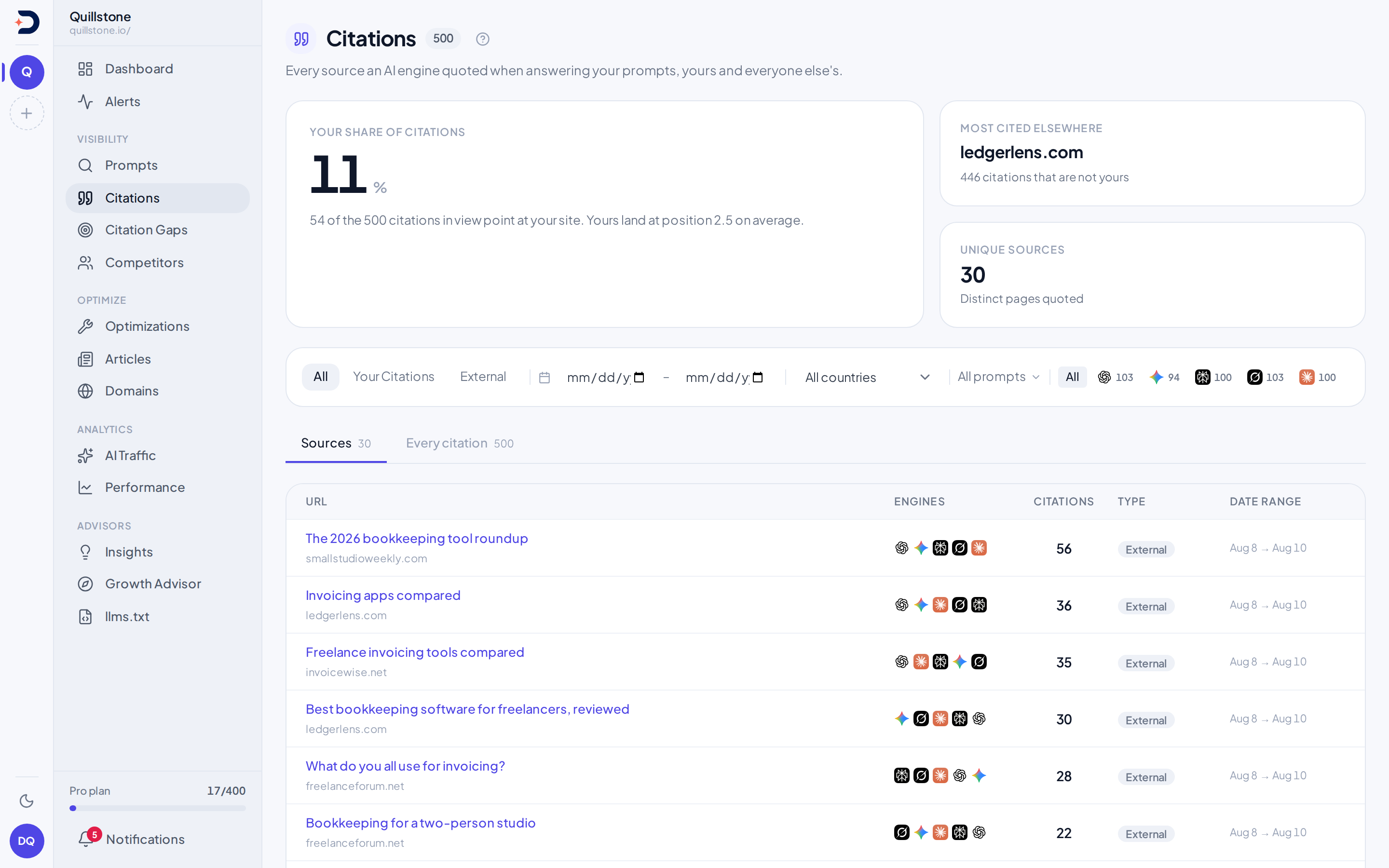
- Your share of the citations: see what share of the citations in view point at your domain, beside the domain cited most often that is not yours and how many distinct pages were cited.
- By page or one by one: group citations by URL with the engines that cited each one, or list every citation with its rank in its answer.
- Brand evidence inside cited pages: see literal brand and competitor matches in saved source text, with evidence snippets and fetch dates. Find competitor mentions without your brand, and see which pages remain unknown alongside your source-mention rate. Explicit AI review on Starter, Growth and Pro helps distinguish real brand references from unrelated name matches, with quoted evidence, uncertainty and team corrections. Combine include-all, include-any and exclude brand filters. Save dated snapshots and compare compatible literal or reviewed evidence, with changed aliases and unknowns kept explicit. Explore mention history.
Flagship Agent
Citation Gap Finder
On Starter, Growth and Pro and during the product trial, when an AI engine cites a competitor instead of you, the Citation Gap Finder reads the winning page and names the exact change that would close the gap: a comparison table, an FAQ, missing statistics, weaker schema, or stale content. It doesn’t hand you an undifferentiated to-do list: it builds a queue ranked by impact score, with the effort and confidence of each fix beside it, so you always know the single highest-value fix to make next.
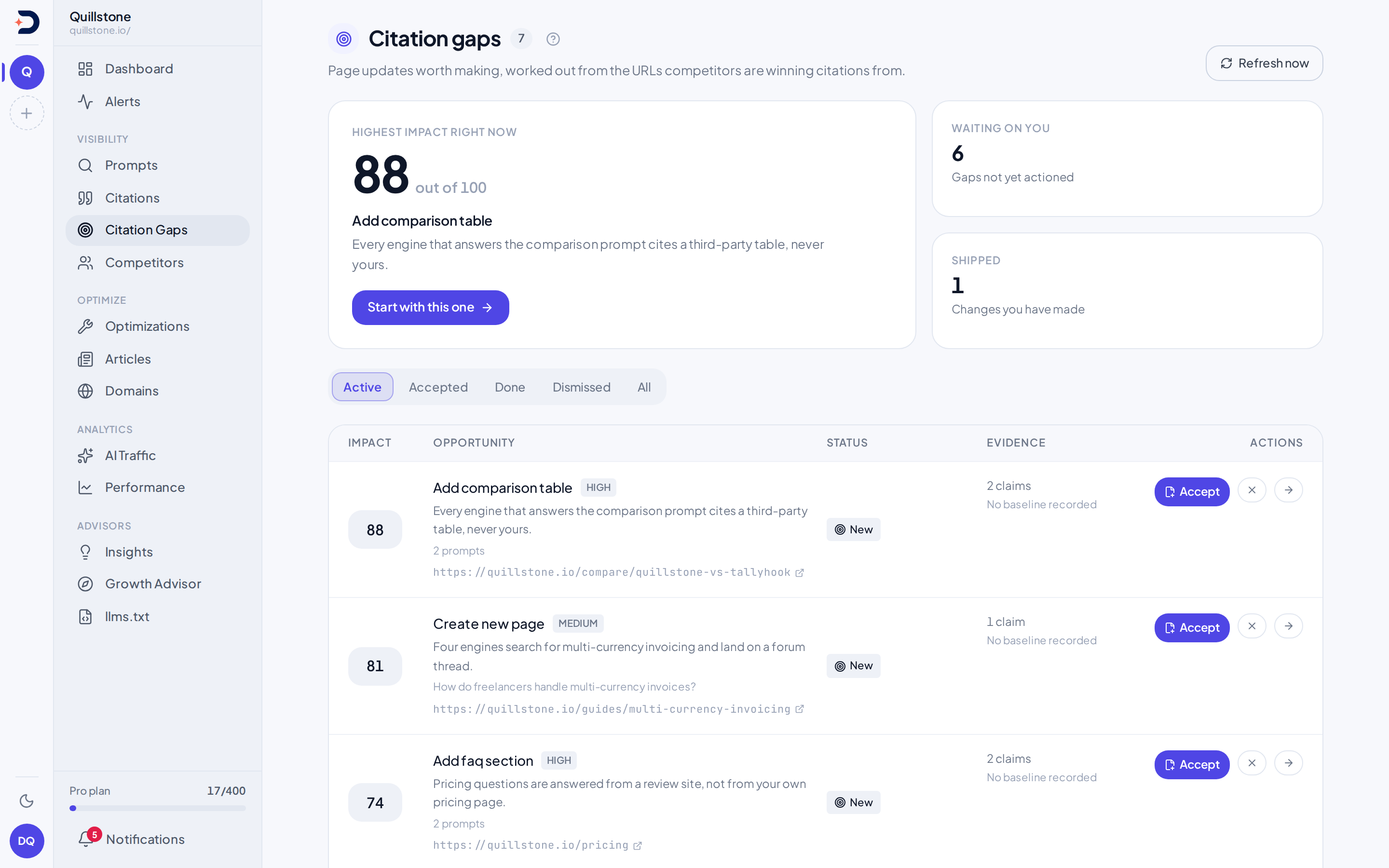
- Ranked, evidence-backed queue: every gap ties to a real page an AI engine cites, scored from the competitor's share of the citations, how low your own visibility is on those prompts, and the evidence found.
- The exact fix, clustered: a specific change to a specific page, or a new page where you have none, and because one page answers many prompts, a single fix can lift a whole cluster.
- What followed: after you ship a change, it tracks your visibility at 7, 14, and 30 days against the recorded baseline. These observations do not establish that the edit caused the change.
Reach and Movement
Source reach and consistency
Rank every cited site over a 7, 28 or 90 day window by how many of your prompts it covers and how reliably it shows up on them, so you can tell a source the engines lean on constantly from one that was quoted once. It measures what was observed, not editorial authority.
Source comparison adds equal-period citation rates, percentage-point movements and owned-source share, with counts and separate recorded collection channels. Save project watchlists of cited domains or exact URLs, subscribe to observed citation gains and losses through team notifications and eligible owner email, inspect their influence and literal brand evidence from saved page text, and revisit selected sources without changing comparison denominators.
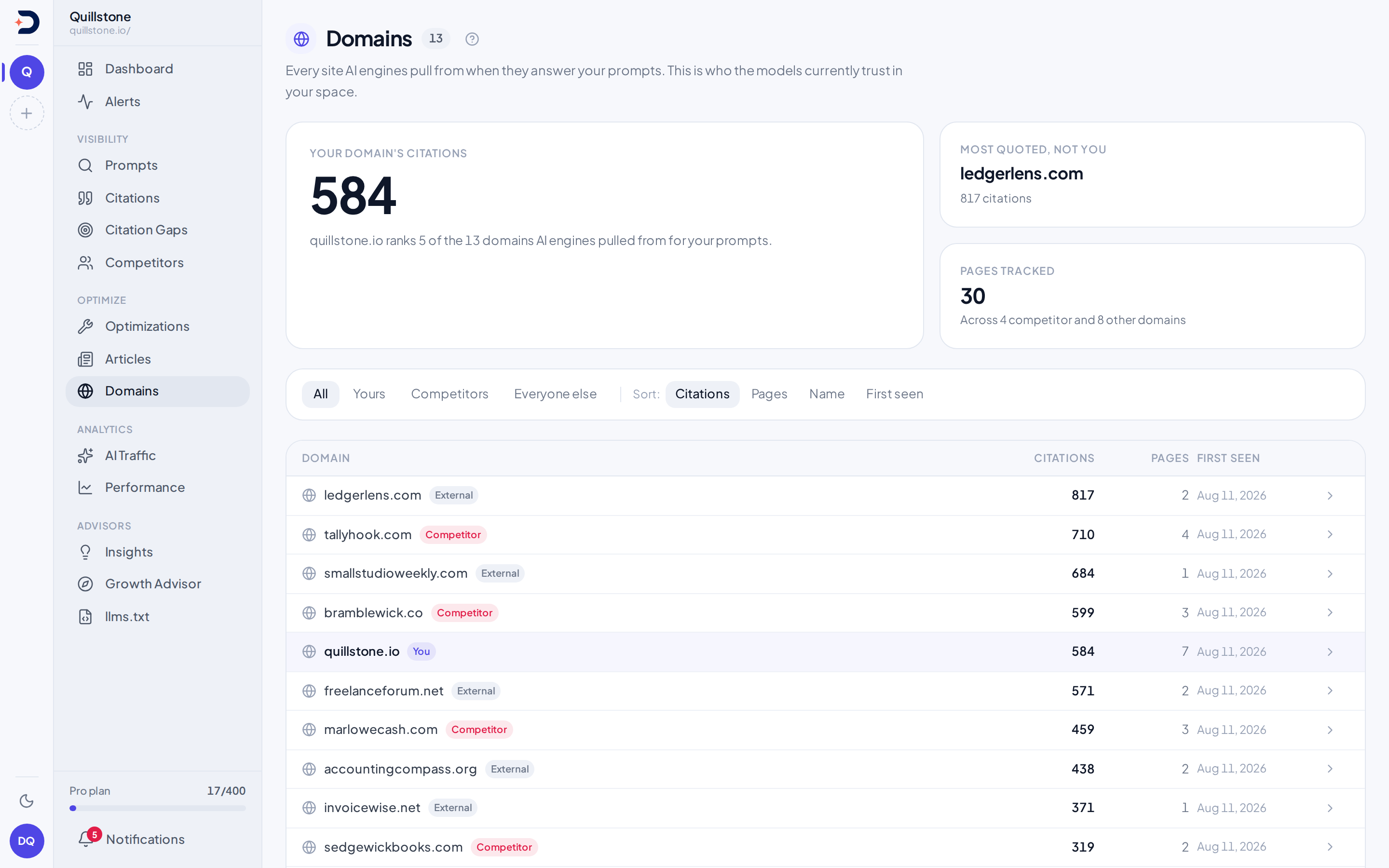
- Reach times consistency: the expected figure multiplies the two, and reads as how many of your prompts would be expected to cite the source if each of them ran once more.
- Owned-source share: your domain's share of all domain appearances, counting a domain once per answer, so repeated links cannot inflate it.
- Sources that disappeared stay visible: source movers lists every domain cited in either period, with its rate in each and the change in percentage points.
Returned and Credited
Retrieved vs cited
For Claude, Perplexity and Grok, the engines whose returned pages can be compared, see which pages each one returned while answering your prompts and which ones the answer text actually credited, one collection channel at a time. Find the pages engines returned but did not credit, then open any URL to see where it was returned and attributed, the passages behind each attribution, tracked brand matches and our saved copy of the page. Available to every project member on all plans.
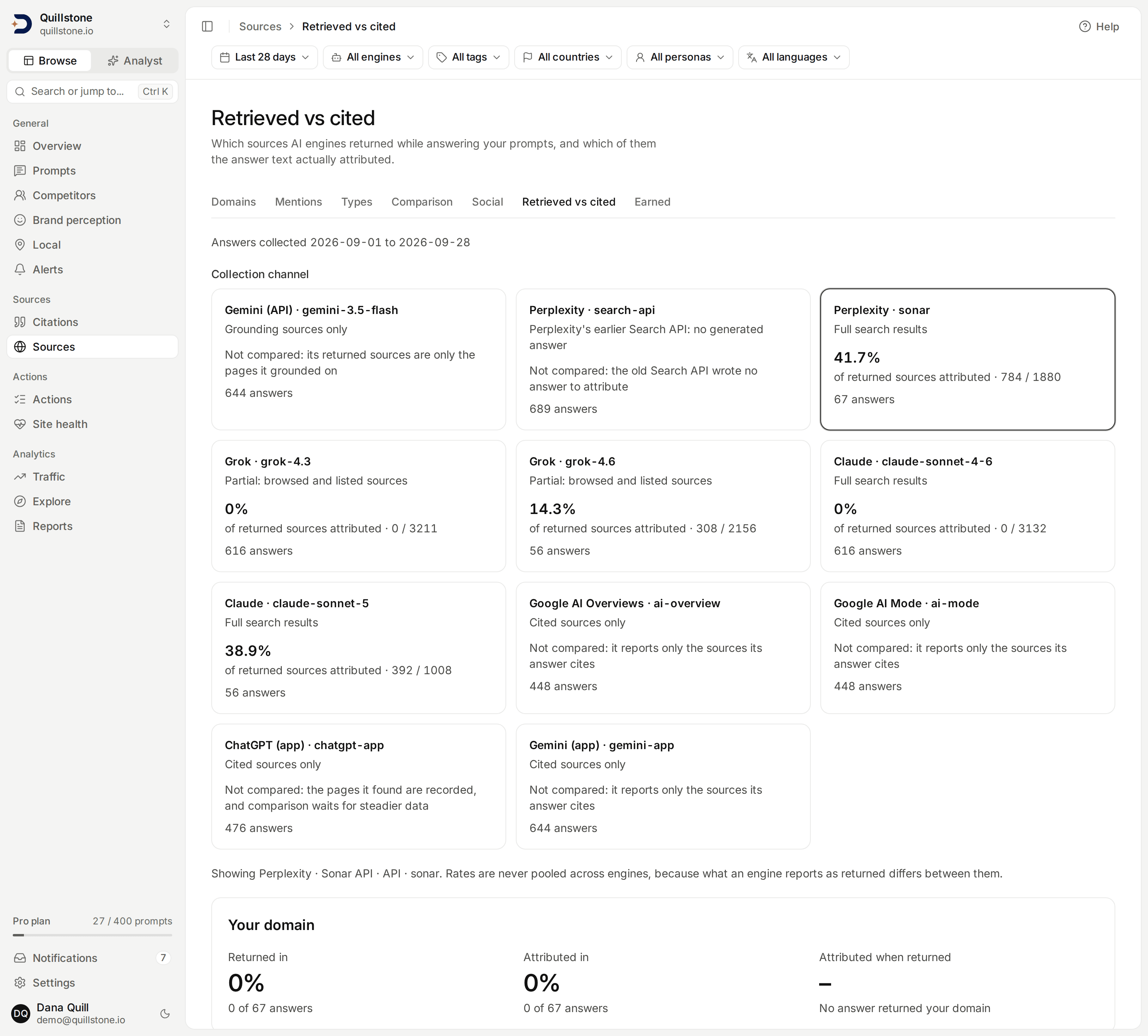
- Compared only where it is fair: rates are computed for Claude, Perplexity and Grok. Gemini (API) reports only its grounding sources, and Google AI Overviews, Google AI Mode and Gemini (app) report only the sources they cite. ChatGPT (app) also reports the pages it found, which are stored, but its citations carry no text positions, which the attributed figure needs, so it is not compared yet. Those five channels show an answer count and no rate.
- Your domain: how often it was returned, how often it was attributed, and how often it was attributed when it was returned.
- Stricter than a citation: a source counts as attributed only when the answer text credits it, so Claude, which records every search result as a citation, is not shown crediting everything it found.
Outreach
Earned-source outreach pipeline
Save cited third-party pages with evidence, or add a prospect by hand before AI answers ever cite it, assign teammates, track outreach and report placements. Compare subsequent page citations with counts and separate collection channels; observed changes do not establish cause. Your team handles outreach externally.
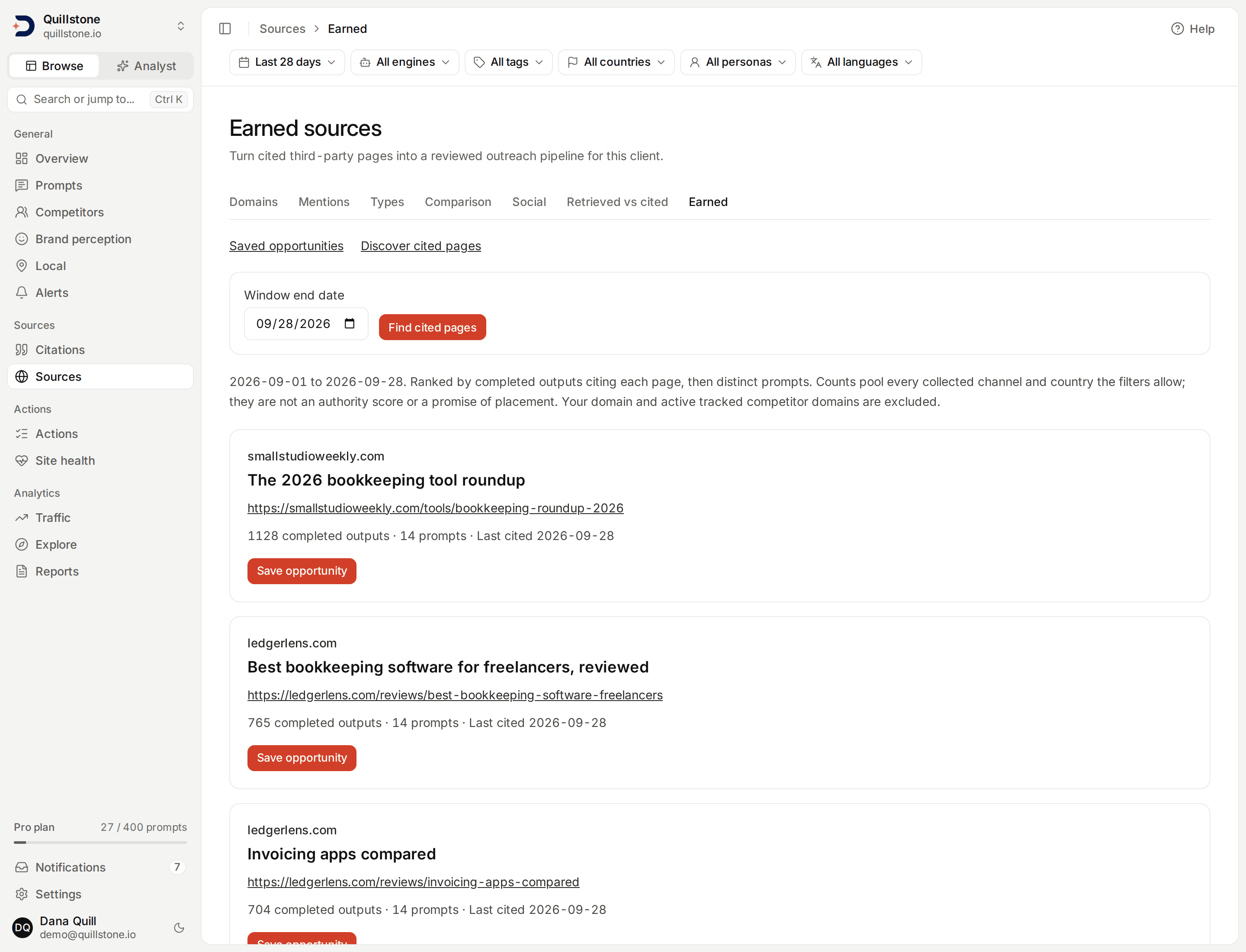
- Third-party pages only: discovery ranks the pages cited in your answers by how many answers cited them, leaving out your own domain and your active tracked competitors.
- Evidence kept as it was: each saved page keeps up to five citation examples as they were read when you saved it.
- A full period on each side: after a reported placement, the comparison waits until the whole period after it has passed, and leaves the placement day out of both sides.
Organize
Source categories and page formats
Organize cited pages by category, format and ownership. Inspect the evidence behind rule suggestions, set page or domain overrides, and keep each client's labels private to its project.
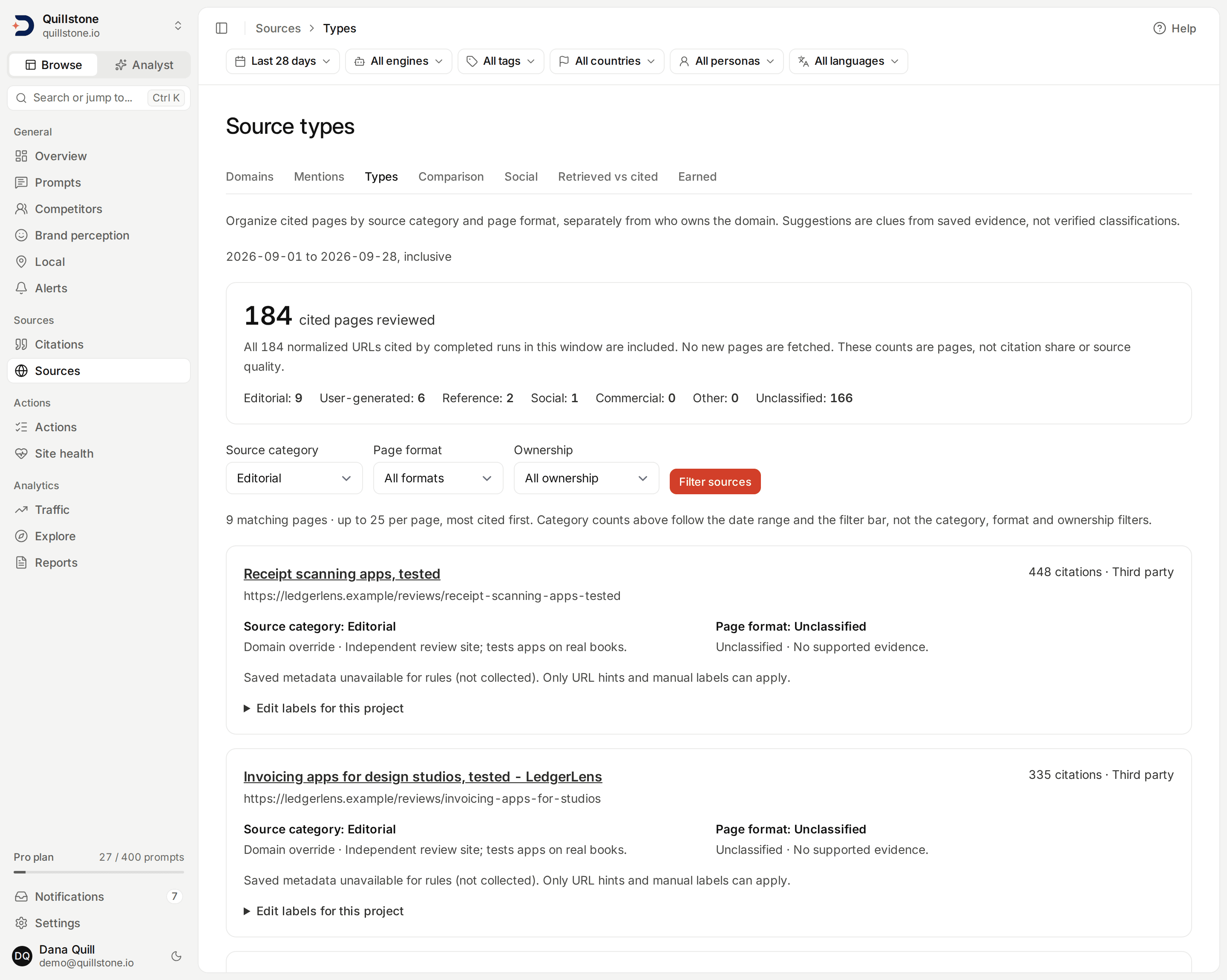
- Two separate labels: a source category (Editorial, User-generated, Reference, Social, Commercial, Other or Unclassified) and a page format such as article, listicle, comparison, FAQ or documentation.
- Suggestions, not verdicts: rule suggestions come from the URL and saved page metadata, with no AI model, and Editorial does not mean independent or trustworthy.
- On every plan: owners and editors set overrides, and every member can read the labels and their evidence.
Docs
Learn more in the docs
Citations
What counts as a citation, how one is attributed to you, and what the screen shows.
Citation gaps
How a gap between you and a cited competitor is detected, ranked, and actioned.
Domains
What counts as a domain here, how far each source reaches across your prompts and how consistently, brand evidence inside cited pages, what an owned page is, and what each daily snapshot records.
Source comparison
Compare domain citation rates across equal periods and read owned-source share with explicit counts, recorded channels and missing-data limits; save domain or exact-URL watchlists and subscribe to observed citation gains and losses.
Retrieved vs cited
See which sources each AI engine returned while answering your prompts and which ones the answer text actually attributed, one collection channel at a time, with a saved-copy drill-down for every URL.
Earned sources
Save cited third-party pages or add one by hand, assign outreach work, report placements and compare subsequent page citations, including recorded address variants, with explicit measurement limits.
Social sources
See which social, community, video, publishing, developer and review accounts AI engines cite, labelled as yours, a tracked competitor's or unlabelled from the cited URL alone, with reach, consistency, influence and period-over-period change per account.
Source types
Organize cited pages with source categories, page formats, rule evidence and project-specific overrides.
Which plan includes each engine and feature is on the pricing page.
Ready to see your AI visibility?
Start monitoring how AI search engines talk about your brand.
Start free
Communities and Reviews
Social sources
On Starter, Growth and Pro, see which subreddits, YouTube channels, LinkedIn pages, review sites and other social accounts your AI engines cite, labelled from the cited URL alone as yours, a tracked competitor's or unlabelled. Reach, consistency and influence per account, period-over-period change, and prompts where only a competitor's account was cited.