Features
Brand perception
Learn how AI answers describe your brand: the tone, the reasons they give, what you are known for, and the facts they get wrong.
Sentiment
Sentiment and framing
On every plan, track whether AI engines describe your brand positively, neutrally, or negatively. On Starter, Growth and Pro and during the product trial, compare it with the competitors you track.
Compare positive, neutral, negative and unclassified brand mentions over 7, 28 or 90 days. Follow daily positive share within a collection channel and inspect the stored evidence. Small samples are marked provisional. Filter by current prompt intent, buyer stage or theme, compare recommendation roles, and inspect citation framing reasons and evidence in a separate view.
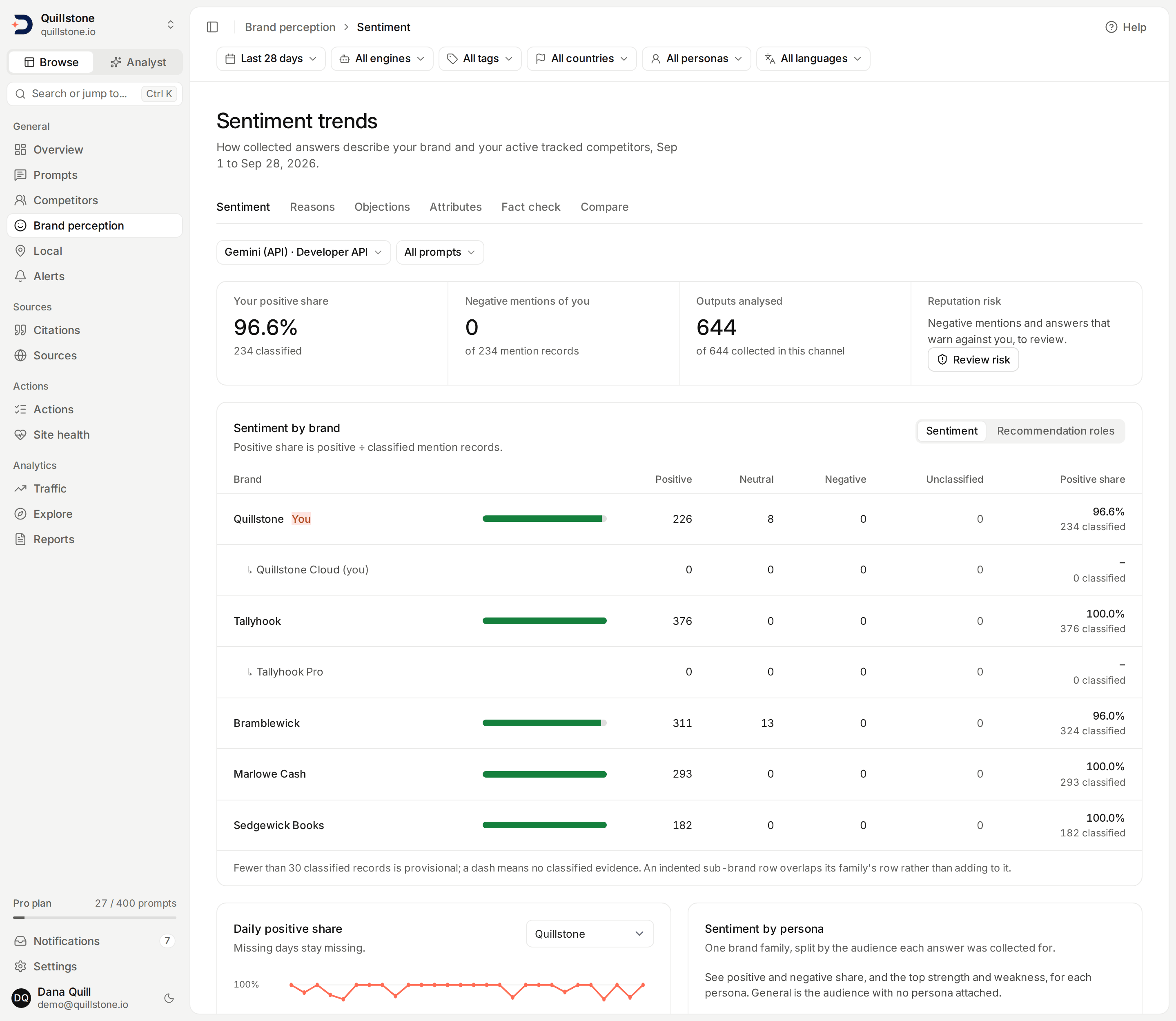
- Reputation-risk evidence: review negative mentions together with saved warning or not-recommended roles, with excerpts and links to collected outputs. These are review signals, not verified harm.
- Collection channels kept apart: each channel is one engine and one way of collecting it, so an answer from a model's API is never averaged with one from a consumer app.
- Unclassified is not neutral: a mention with no saved sentiment label is counted on its own and left out of the positive-share denominator.
- By persona: for one brand, see positive and negative share for each audience you track.
Head to Head
Compare vs. competitor
A controlled comparison restricted to the answers naming both your brand and one competitor you choose: coverage, who is named first, sentiment and role mix, and, on Starter, Growth and Pro, the same reason and category rates as Brand reasons, all computed on that shared population. The competitor side needs a tracked competitor, included on Starter, Growth and Pro and during the product trial.
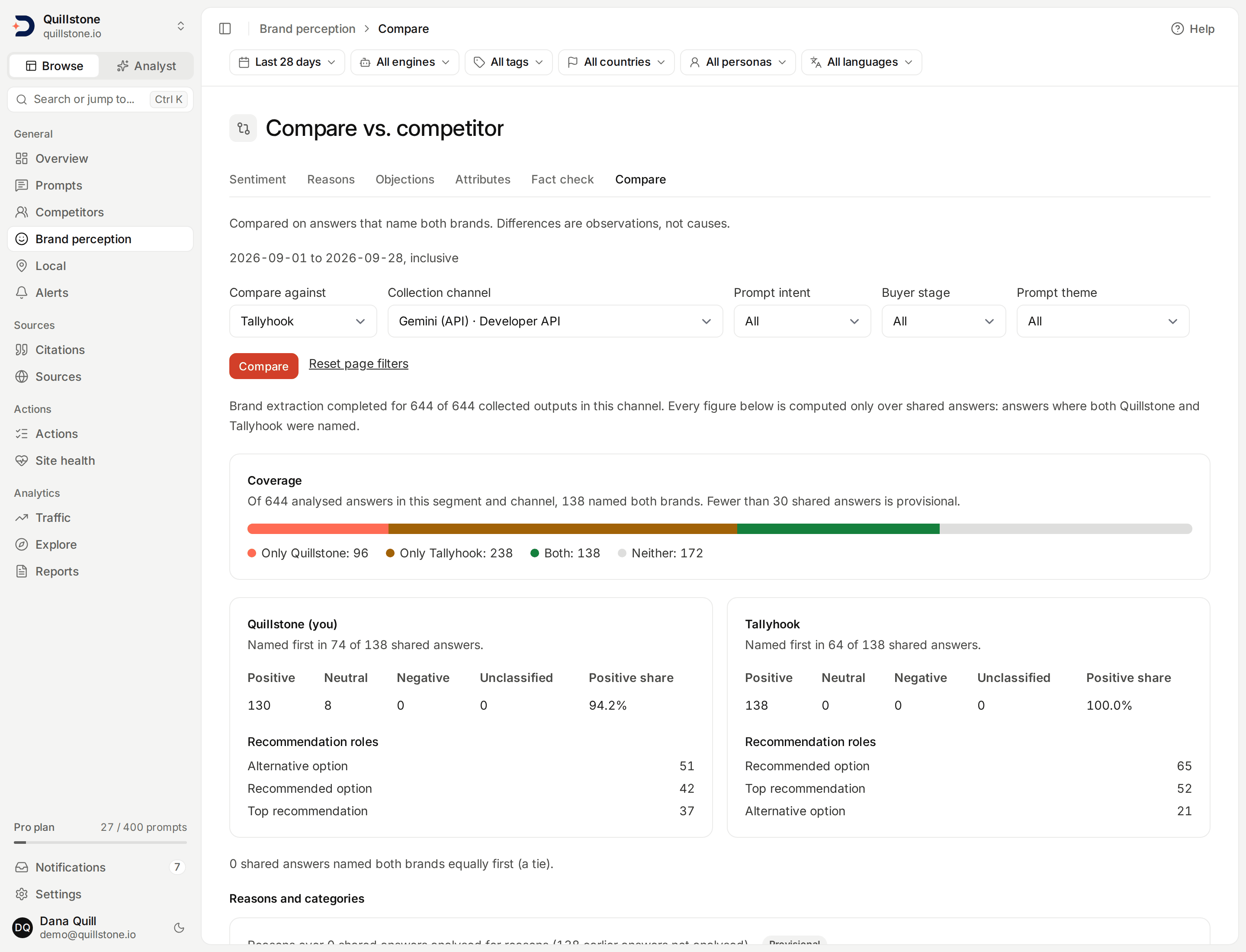
- Only you, only them, both, neither: a coverage bar splits every analysed answer four ways before the comparison narrows to the answers naming both.
- Ties counted as ties: when both brands are first named at the same point in an answer, it is a tie, credited to neither side.
- Paired evidence: open any row of the per-prompt table to read both brands' saved quotes, sentiment and role from the same answer.
- No winner score: the two sides are set next to each other from saved evidence, with no composite score and no claim about why they differ.
Reasons
Brand reasons
On Starter, Growth and Pro, see why AI answers favour or caution against your brand and each tracked competitor. In each analysed answer, up to three reasons per brand, such as pricing, features, integrations or support, are counted as strengths or weaknesses, with the exact quote from the answer behind each count. Group the thirteen reasons into six fixed categories, or break either view out by persona. Answers analysed before this feature are shown as not analysed, never as having no reasons.
- Every quote is in the answer: before a reason is saved, its quote is looked up in the saved answer text, and a reason whose quote cannot be found there is discarded.
- Rates you can check: each rate is the answers giving that reason in that direction, divided by the answers analysed for that brand, and a brand with fewer than 30 analysed answers is marked provisional.
- Export, API and MCP: the same reasons reach a file export, the customer API and the MCP connector.
Weekly Study
Objections
On Starter, Growth and Pro, a study asks each chat engine on your plan, and ChatGPT (app) (not Google AI Overviews, AI Mode or Gemini (app)), why a buyer might not choose your brand and each active tracked competitor. It runs every week, and owners and editors can also run it on demand, at most once a day. Each objection is ranked by where it appears in the answer, grouped with the same objection from other engines and brands, and shown with the quote from the answer and, where the engine records where it placed its citations, the sources it cited there. See which objections engines list first, whether competitors face the same ones, and what changed since the last comparable study. The question asks for downsides, so most brands get some: compare them rather than reading them as a verdict. Studies are separate from your tracked prompts and change no visibility metric.
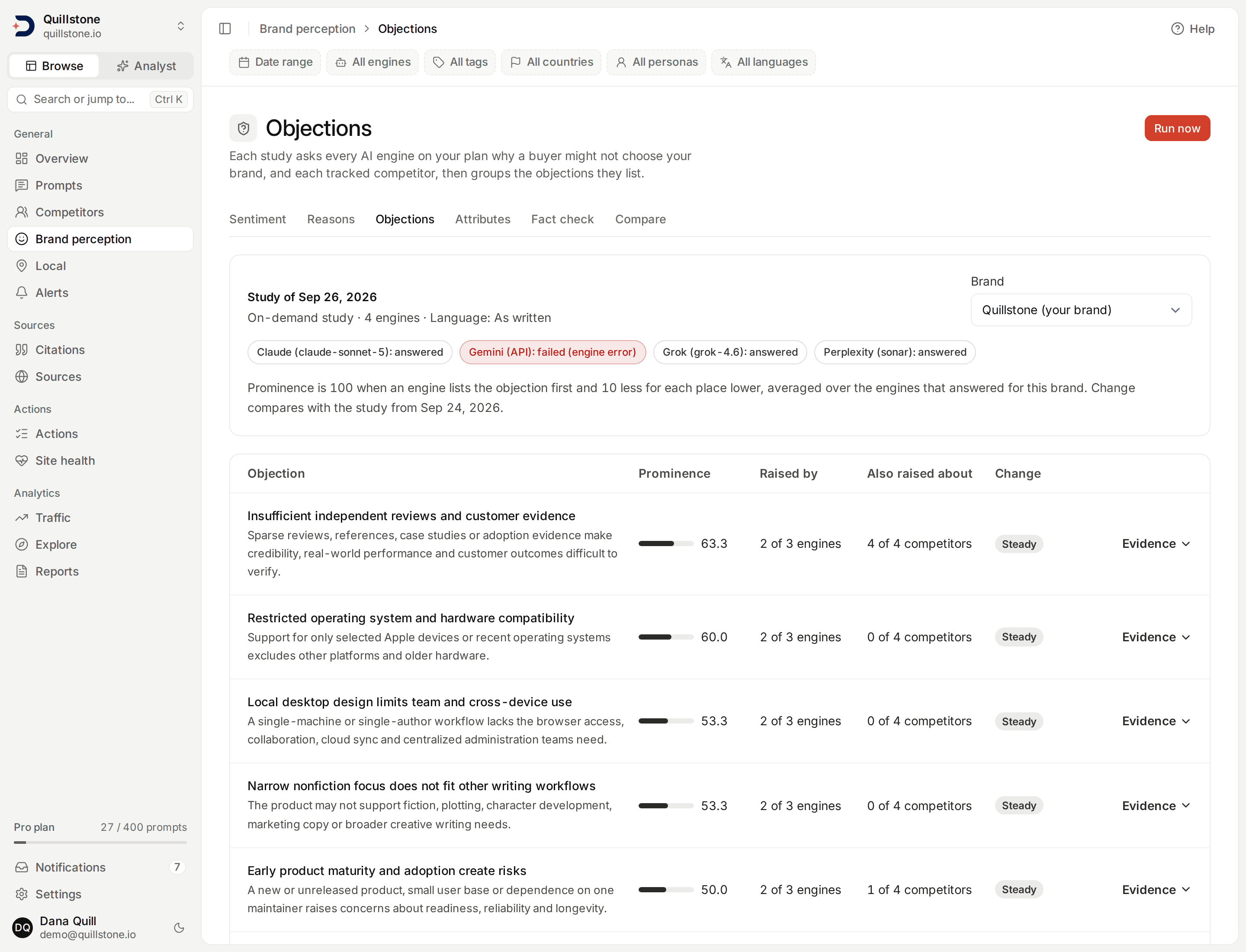
- Prominence across engines: each engine scores an objection by how early it listed it, and an engine that answered without raising it scores 0, so prominence is the average over every engine that answered.
- Category or just you: on your own brand, see how many competitors had the same objection raised about them.
- Sources linked by our code: a source is tied to an objection only where the engine placed a citation on the quote or right after it, never by asking a model to match them.
Weekly Study
Attributes
On Starter, Growth and Pro, a weekly study asks each chat engine on your plan, and ChatGPT (app) (not Google AI Overviews, AI Mode or Gemini (app)), what your brand and each active tracked competitor are best known for, then asks, without naming your brand, which brands in the market you name are best known for the strongest of those qualities and for up to ten attributes you choose. See each brand's association with a quality next to its market prominence for it, where it ranks among every brand named, and who leads, tracked or not, with the quotes behind them and what changed since the last comparable study. Owners and editors can also run it on demand, at most once a day. Studies are separate from your tracked prompts and change no visibility metric.
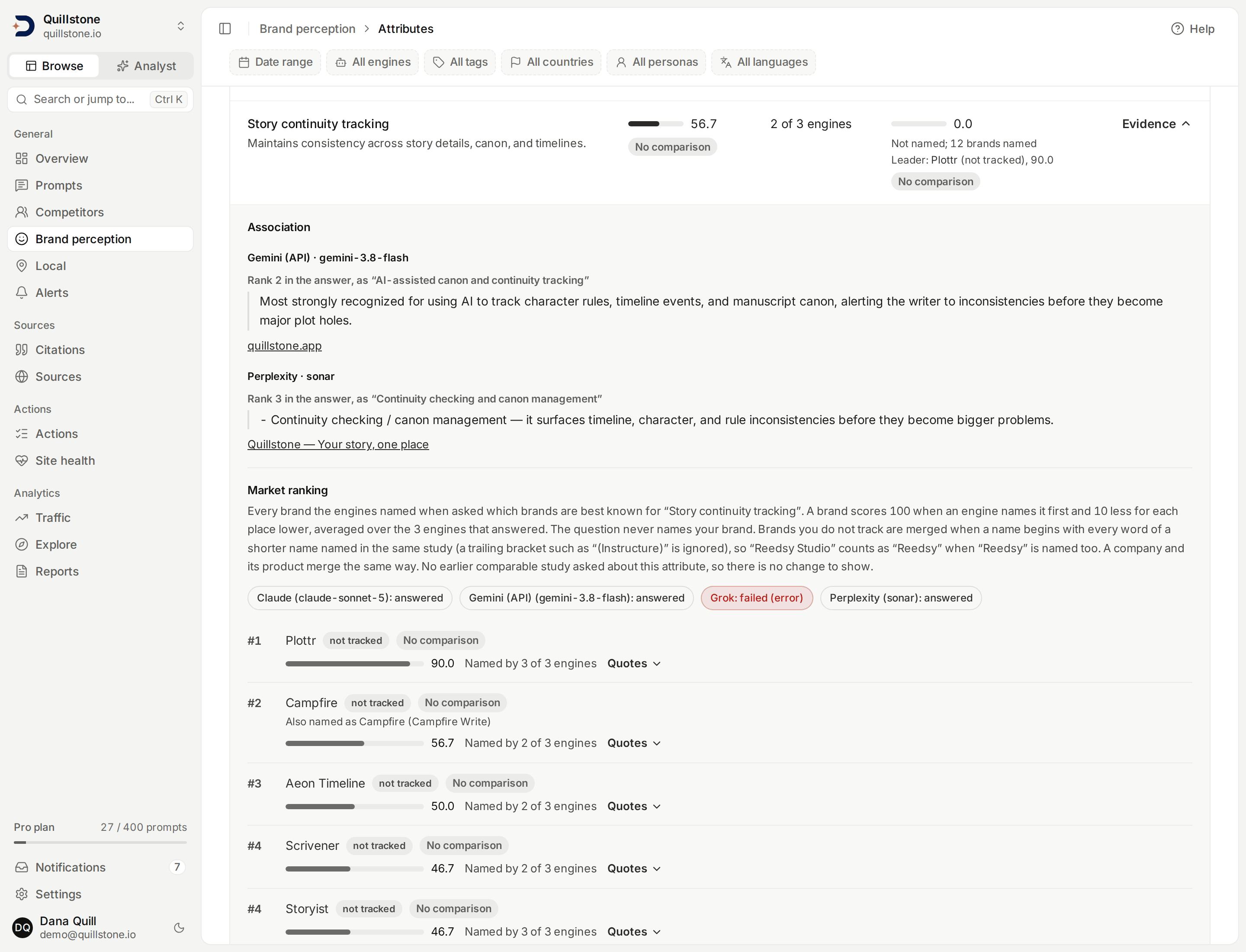
- Known for, and known as the one for: association and market prominence are shown side by side because they can disagree. Every engine can describe a brand as fast and still name another brand first when asked who is known for speed.
- Your market, in your words: owners and editors set the short market phrase the questions name, and your site research can suggest one.
- The leader can be anyone: the brand with the highest market prominence for a quality is shown as its leader, whether or not you track it.
Accuracy
Fact check
On Starter, Growth and Pro, keep a list of approved facts about your brand, such as pricing, founding, availability and policies, typed by your team or drafted from your own site and approved before use. A weekly study asks each chat engine on your plan, and ChatGPT (app) (not Google AI Overviews, AI Mode or Gemini (app)), about each category you have facts in, except Other, and the answers to the tracked prompts you choose are checked as they arrive. An AI model judges whether each answer supports or contradicts each fact; our code keeps a finding only when its quote is found in the answer and its fact is one of yours, and links the sources the engine cited there. Contradictions wait in a review queue, where your team confirms or overturns them or marks your own fact as out of date, and raise an alert. See accuracy per fact and per engine, and what changed since the last study.
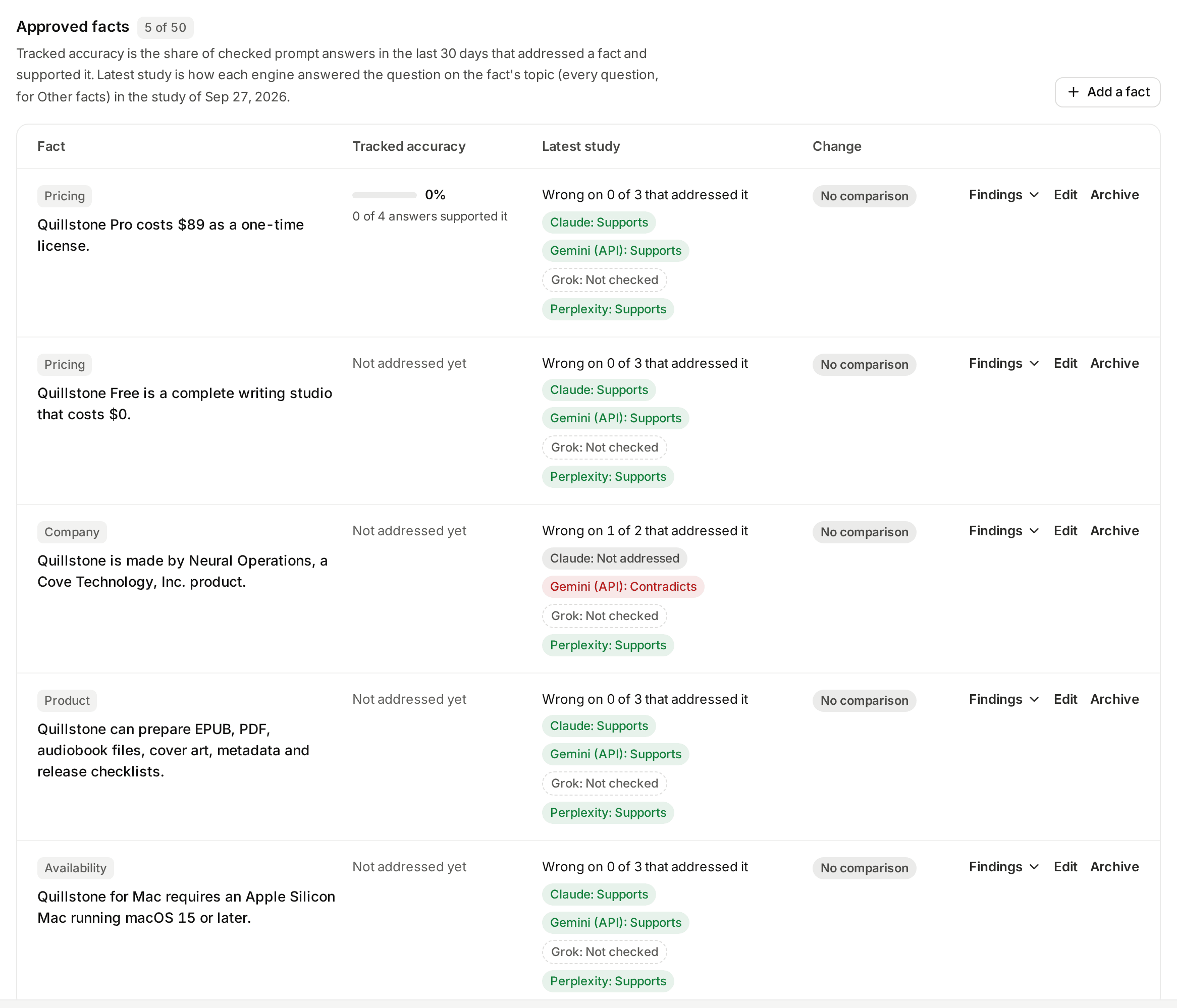
- Questions that do not lead: the study asks about your brand by its name and domain, never with the text of a fact, so the engine is not steered toward the answer you want.
- Checked prompts: choose up to 10 tracked prompts, and their new answers are checked against your facts as they arrive, up to 200 checks a day, with any answer skipped by that limit counted on screen.
- A verdict your team owns: mark a contradiction confirmed wrong, mark that the answer agrees with the fact, mark your own fact out of date, or mark it not relevant, and add a note.
Docs
Learn more in the docs
Sentiment trends
Compare sentiment by prompt segment, collection channel and persona, including sub-brand rows and a by-persona view, review negative or warned-against brand evidence, inspect separate citation framing, and jump to the controlled comparison.
Compare vs. competitor
A controlled comparison against one active competitor over the answers that name both, with coverage, named-first, sentiment and reasons.
Brand reasons
See why AI answers favour or caution against your brand and each tracked competitor: pricing, features, support and ten other reasons, each counted as a strength or a weakness with the quote behind it, grouped into six categories or broken out by persona.
Objections
A weekly study that asks each chat engine on your plan, and ChatGPT (app), directly why a buyer might not choose your brand and each active tracked competitor, then ranks the objections by prominence with the quotes behind them and shows what changed since the last comparable study.
Attributes
A weekly study that asks each chat engine on your plan, and ChatGPT (app), what your brand and each active tracked competitor are best known for, then which brands it names for each chosen quality, and shows each brand's association and market prominence side by side, with the quotes behind them and what changed since the last comparable study.
Fact check
Keep a list of approved facts about your brand, then see where AI engines get them wrong: a weekly fact study and the answers to up to ten tracked prompts you choose are checked against them, with each contradiction quoted from the answer, linked to its sources and queued for your team to review.
Which plan includes each engine and feature is on the pricing page.
Ready to see your AI visibility?
Start monitoring how AI search engines talk about your brand.
Start free